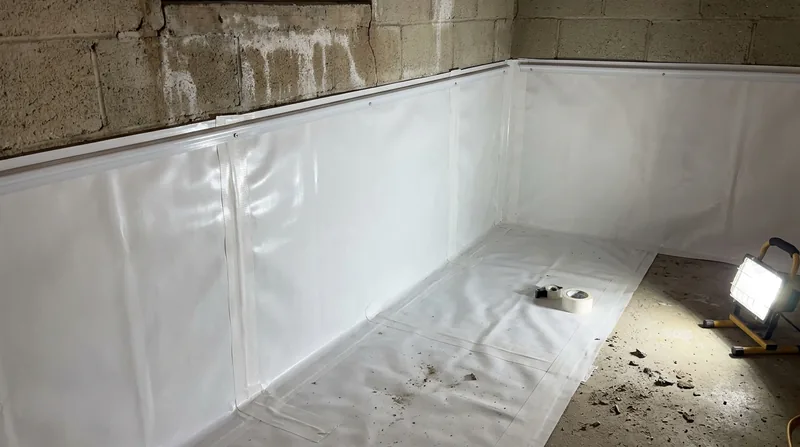




Norfolk sits barely above sea level on sandy and silty Tidewater soil over clay, with the water table only a few feet down. That means ground moisture vapor is constantly pushing against your foundation walls and slab, not just during storms. If you own a 1920s brick foursquare in Ghent, a raised-brick Tudor in Larchmont, or a slab-on-grade ranch in Wards Corner, that vapor finds its way in through porous masonry and cold joints. Vapor Barrier Installation in Norfolk is how you stop it at the source: heavy-duty barrier sheets across lower-level walls and slab, sealed seams, taped terminations, and sump integration where needed. We install these systems specifically for Hampton Roads humidity, not for a dry climate that does not exist here. If you are already seeing efflorescence or a musty smell, start with a free basement inspection so we can tell you whether vapor control alone will do the job.
Why Vapor Barrier Installation Matters in Norfolk's Tidewater Soil
Most of the water problems we diagnose in Norfolk are not from a single crack. They come from vapor drive: warm, humid summer air meets a cool foundation wall, and moisture condenses on the surface and inside the masonry. Add a water table a few feet down and nor'easter rain pushing against the foundation, and the lower level stays damp all year.
- Brick and block foundation walls in Ghent and Colonial Place wick ground moisture upward, which shows up as white efflorescence and peeling paint.
- Slab-on-grade homes in Lochhaven and Azalea Acres pull vapor straight through the slab, so the floor feels damp even when no water is visible.
- Raised brick foundation walls in Riverview and Larchmont have old mortar joints that let vapor pass where the parging has failed.
- Window wells and below-grade stairwells collect rain and funnel vapor against the wall right where the barrier needs to terminate.
A properly sealed vapor barrier closes those paths so the space stays drier through July and August, when Hampton Roads humidity peaks.
Key info: A homeowner in Colonial Place called us about a musty smell in a 1918 cellar. The walls were dry to the touch but tested damp at the base. We installed a sealed wall and slab vapor barrier with a sump tie-in, and the moisture readings dropped within two weeks.
For the official rules on any work that alters drainage or a sump discharge connection, check with the City of Norfolk building department before scheduling.
How We Install Vapor Barriers in Norfolk Homes
We start by finding where the vapor is actually coming from. That means checking wall moisture, slab moisture, the sump pit, and any window well or stairwell terminations. Then we build the barrier around what the house actually has, not a one-size template.
- We map moisture readings across the walls and slab and mark the terminations at the footing and the rim.
- We prep the surface: remove loose parging, scrape efflorescence, and fill cracks and cold joints with hydraulic cement or epoxy where needed.
- We cut and fit heavy-duty barrier sheets to the wall and slab, overlapping seams by at least six inches.
- We seal every seam and termination with compatible tape and mastic so vapor cannot bypass the sheet.
- We integrate the barrier with the sump basin and discharge line, and we check the check valve while we are in the pit.
- We leave a clean, labeled installation and walk you through what to watch for after the next heavy rain.
If the diagnosis points to active water rather than vapor, we will tell you plainly, and an interior drain tile system is usually the better answer than a barrier alone.
Key info: On a 1952 brick ranch in Wards Corner, the slab was dry at the edges but wet in the center. We ran a slab vapor barrier tied into a new sump basin, and the homeowner stopped running a dehumidifier around the clock.
Vapor Barrier Options We Use in Norfolk
Not every lower level needs the same sheet or the same termination detail. Here is how we match the approach to the building stock we see across Norfolk, Portsmouth, and Chesapeake.
| Approach | Description | Best for |
|---|---|---|
| Wall vapor barrier | Heavy-duty sheet sealed to the wall, taped at seams and terminated at the footing. | Brick and block walls in Ghent and Colonial Place with efflorescence and damp surfaces. |
| Slab vapor barrier | Sheet laid across the slab with sealed laps and a tied-in perimeter detail. | Slab-on-grade ranches in Lochhaven and Azalea Acres with damp floors. |
| Wall and slab combined system | Continuous barrier from wall to slab with a sump integration point. | Partial basements and cellars where both surfaces read damp. |
| Dimple board drainage mat | Drainage mat against the wall to relieve hydrostatic pressure before the barrier goes on. | Walls with active seepage where a barrier alone would trap water. |
| Sump-integrated barrier | Barrier terminated into the sump basin with a sealed lid and discharge check valve. | Homes with an existing sump pit or a history of pump cycling. |
We choose the combination based on moisture readings, not on what is easiest to sell.
Vapor Barrier Installation Cost in Norfolk: What to Expect
Most vapor barrier work in Norfolk starts from $3 per square foot, and that figure moves based on the wall area, slab area, and how much prep the surface needs. A dry brick wall in Larchmont may need only cleaning and sealing, while a cellar in Berkley with failed parging and active seepage needs crack repair and a drainage mat first. Access matters too: a narrow below-grade stairwell takes longer to work in than an open partial basement.
We recommend getting two or three estimates so you can compare scope, not just the number. A low bid that skips surface prep or seam sealing will cost more later. Our pricing overview breaks down what each line item covers.
Vapor Barrier Installation Near Me: How to Choose a Contractor in Norfolk
Hiring for this work is mostly about verifying the basics. Ask for the contractor's license and insurance certificate, get at least two written estimates with scope spelled out, and ask for references from jobs in Norfolk or the surrounding cities. Confirm who pulls any permit if the work touches drainage or the sump discharge connection, since thresholds vary by jurisdiction and the local building department has the final word. If your home is in a historic district or an HOA, check those requirements before work starts.
Reach out through our contact page to schedule a walkthrough.
Vapor Barrier Installation in Norfolk: Pricing Guide
| Service | Price | Details |
|---|---|---|
| Wall vapor barrier | Starting at $3/sq ft | Includes surface prep, heavy-duty sheet, sealed seams, and taped terminations at the footing. |
| Slab vapor barrier | Starting at $3/sq ft | Includes slab cleaning, sealed laps, and a tied-in perimeter detail at the wall base. |
| Wall and slab combined system | Starting at $5/sq ft | Continuous barrier from wall to slab with sump integration and sealed terminations. |
| Sump-integrated barrier | On estimate | Requires an on-site look at the pit, discharge line, and check valve before quoting. |
| Travel | Included | In Norfolk and surrounding areas, no separate call-out or mileage fee. |
| Estimate | Free | Response within 24h at (757) 698-3671, no obligation to book. |
Indicative pricing, the exact cost depends on square footage, finish, and site access. Free personalized estimate within 24h at (757) 698-3671.


